

Excavation of the Colossal Cavern for Hyper-Kamiokande Completed
In July 2025, the University of Tokyo completed excavation of the colossal cavern that will house the main detector volume of Hyper-Kamiokande, a next-generation, ultra-large water Cherenkov detector currently under construction in Hida City, Gifu, Japan.

The Hyper-Kamiokande (Hyper-K) project is an international scientific research collaboration led by the University of Tokyo and the High Energy Accelerator Research Organization (KEK). As of July 2025, approximately 640 researchers from 22 countries are actively contributing to the project. Hyper-Kamiokande is a next-generation particle detector consisting of a gigantic water tank with a fiducial volume 8.4 times that of its predecessor, Super-Kamiokande, and is equipped with over 20,000 newly developed photodetectors. It is currently being constructed 600 meters underground beneath a mountain in Hida City, Gifu Prefecture, Japan, with the University of Tokyo leading the effort. In parallel, KEK is leading the upgrade of the J-PARC neutrino beam and the construction of a new intermediate detector in Tokai Village, Ibaraki Prefecture. Through the combination of these efforts, the Hyper-Kamioande project aims to precisely measure neutrino properties and to search for proton decay, ultimately contributing to solving fundamental mysteries of the universe and testing the ideas of Grand Unified Theories. The Hyper-K project officially began in February 2020 with the allocation of its initial-year budget.
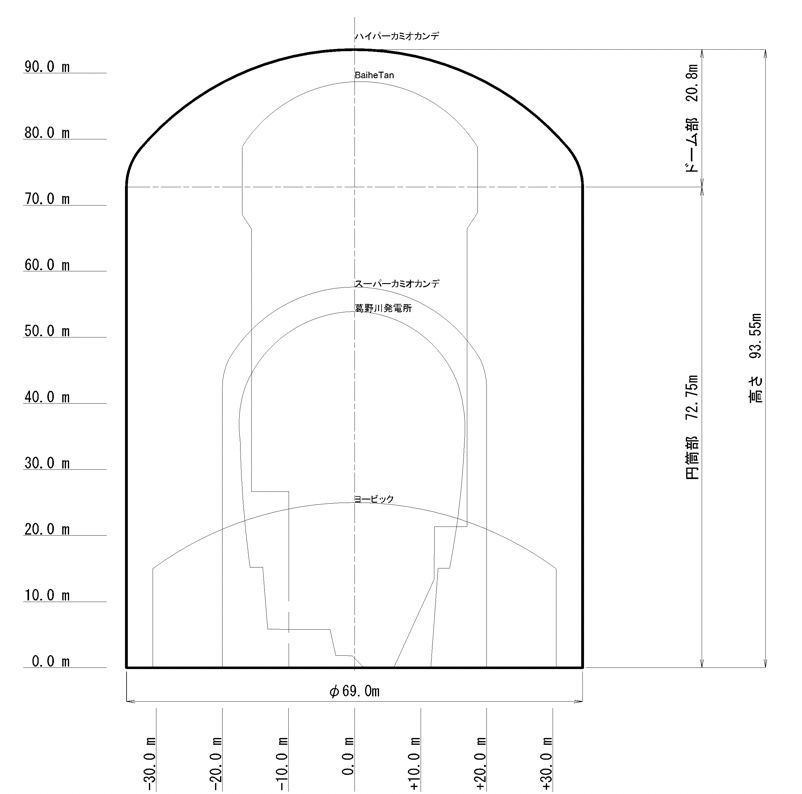
The Hyper-K main cavern consists of a dome-shaped ceiling section approximately 69 meters in diameter and 21 meters high, followed by a cylindrical portion that is 73 meters in height located just below. The cavern is one of the largest man-made spaces ever excavated in bedrock. The construction site features Hida Gneiss, one of Japan's most robust bedrock formations. That said, the characteristics of the rock mass and the state of the in-situ stress in the bedrock significantly influence the stability of the cavern during excavation and even after completion. Prior to excavation, large-scale geological surveys were conducted in fiscal year 2020, resulting in a total of 730 meters of bore holes as well as the excavation of new tunnels. Such surveys have been carried out since the project's earliest stages. Based on the results of these investigations, the cavern design work, which included decisions on its shape and wall reinforcement methods, was carried out in parallel with the excavation of tunnels leading to the construction site.
The dome section of the main cavern is crucial for structural stability as it supports a large vertical in-situ stress through a three-dimensional arch effect. After accessing the top of the dome section via a temporary spiral tunnel, starting in November 2022, the cavern space was expanded outward in stages while the ceiling was stabilized using shotcrete and prestressed anchors. To safely and efficiently carry out this challenging excavation, which involved the risk of ceiling collapse, a “datadriven adaptive design and construction” approach was adopted. This method continuously updates the cavern design based on geological information and real-time measurements of bedrock movement obtained during excavation.
During the excavation of the cylindrical section, which began in October 2023, the efficiency of rock removal was a key factor influencing the pace of construction. To address this issue, a 3.4-meterdiameter vertical shaft was pre-excavated in the center of the cylindrical section down to the access tunnel at it’s bottom. During excavation, generated waste rock was efficiently removed via this shaft and transported by dump trucks from the bottom level to the ground surface. The excavation, progressing in stages, was carried out swiftly with safety as the top priority. Although additional cavern wall reinforcement work, which required large-scale scaffolding, became necessary, the excavation of the main cavern, totaling approximately 330,000 cubic meters of rock, was completed in July 2025, about six months behind the original schedule.
Accordingly, all excavation work for the Hyper-K cavern’s construction has been completed, which is a significant achievement that marks one of the project's most important milestones. Starting in August, construction will begin to transform the main cavern into the gigantic water tank designed to contain 260,000 cubic meters of ultra-pure water. Construction of the two-layer detector structure within the tank will commence in 2026, with installation of photodetectors and other components starting thereafter. In preparation for this phase, mass production of the newly developed 50cm photomultiplier tubes (PMTs) has been progressing smoothly in Japan. Meanwhile, overseas institutions responsible for PMT protective covers, multi-PMT modules, photodetector units for the outer detector, and underwater electronics modules are also in the final stages of transitioning from component development to component mass production. All in-tank detector components are set to be installed by 2027, after which the tank will be filled with ultra-pure water. The Hyper-K detector is scheduled to begin operation in 2028.
Related Links
Hyper-Kamioande project webpage
https://www-sk.icrr.u-tokyo.ac.jp/en/hk/
Contact
Swiss Institute of Particle Physics (CHIPP)
c/o Prof. Dr Paolo Crivelli
ETH Zürich
IPA
Otto-Stern-Weg 5
8093 Zürich
Switzerland